
Why seamless gutters outperform sectional on Long Island
Seamless gutters long island homeowners install today are formed on-site from a single continuous coil of metal — one piece per run, cut to the exact length of each roof section with no mid-run joints. That single design decision eliminates the leading cause of gutter failure on Long Island: joint separation from freeze-thaw cycling.
Nassau and Suffolk County temperatures cross the 32°F mark 30 to 40 times per winter. Every freeze-thaw cycle exerts hydraulic pressure on the caulked joints of a sectional system. After 8 to 12 years, those joints crack, and water begins routing behind the fascia instead of down the downspout. What follows is a predictable sequence: rotted fascia, paint failure, soffit damage, and eventually water intrusion at the foundation or roofline.
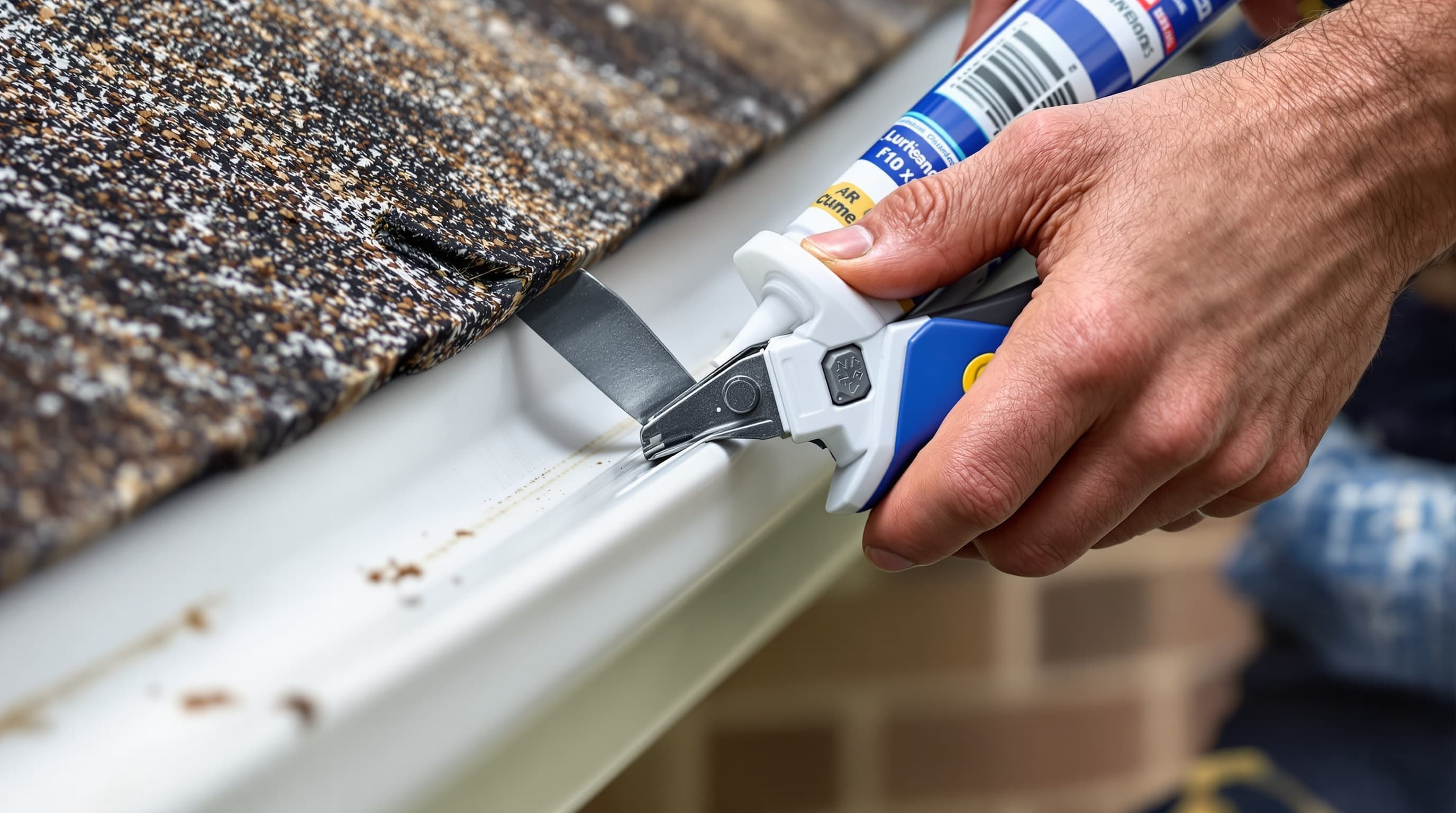
Seamless gutters sidestep this failure mode entirely. The only seams are at mitered corners and downspout outlets — roughly 4 to 6 seam points on a typical Long Island home versus 15 to 25 joints on a sectional system of comparable length. Those corner seams are sealed with butyl sealant and stainless rivets, not silicone that degrades in UV exposure. A properly installed seamless aluminum gutter on a Nassau or Suffolk home should last 20 to 30 years without mid-life joint repairs.
Seamless aluminum vs copper vs steel: which is right for your home
The material choice on Long Island is largely driven by two factors: proximity to saltwater and architectural style of the home.
Seamless aluminum — the standard for most Long Island homes
Aluminum is the right choice for the majority of Nassau and Suffolk residential homes: 1950s through 1990s capes, colonials, ranches, and splits more than a half-mile from saltwater. It comes in a wide color range, is lightweight enough not to require heavy fascia reinforcement, and runs $8 to $12 per linear foot installed in 6-inch K-style. On Long Island, aluminum gutters in a non-coastal environment typically last 20 to 25 years with normal maintenance.
The one limitation is salt-air exposure. Within a half-mile of the Sound or Great South Bay, aluminum gutters begin showing surface pitting and oxidation by year 8 to 12. In direct waterfront positions — bay-facing homes in Bay Shore, Islip, Massapequa Park, or on the North Shore in Huntington and Cold Spring Harbor — that timeline can compress to 5 to 7 years. For these homes, aluminum is a false economy.
Copper — for historic homes and coastal properties
Copper is the premium material on Long Island for two distinct use cases: historic homes that demand architectural authenticity, and coastal properties where no other metal is as durable.
Tudor and Colonial Revival homes in Garden City, Victorian-era homes in the Islip hamlet and Bay Shore historic district, and Craftsman bungalows throughout Nassau County were designed for round-profile half-round gutters — K-style aluminum on a pre-1940 home is both an architectural mismatch and a material one if the roof already has copper valleys or flashing. Running aluminum against copper flashing creates a galvanic couple that accelerates aluminum corrosion at the contact point.
Copper gutters installed on Long Island run $18 to $28 per linear foot for half-round profile with soldered seams. The premium is real — but on a home that will retain or appreciate in value over 50-plus years, copper is often the right long-term call. Copper develops a natural patina that requires no painting and provides inherent corrosion resistance in salt-air environments that aluminum simply cannot match.
Galvanized steel — the coastal value choice
26-gauge galvanized steel sits between aluminum and copper on both price and durability for salt-exposed locations. For South Shore homes in direct bay proximity where copper isn't justified by the home's architecture or value, heavy-gauge steel is the correct call — it resists salt-air corrosion substantially better than aluminum without the cost premium of copper. Expect 20 to 30 years in direct coastal exposure with proper maintenance.
Gutter sizing on Long Island: why 6-inch is now the standard
Long Island homes built before 1990 were overwhelmingly fitted with 4-inch or 5-inch K-style gutters and 2x3 downspouts. That sizing was adequate for the storm intensity of the 1960s through 1980s. It is not adequate for Long Island's current storm pattern.
Peak rainfall rates during Nassau and Suffolk summer thunderstorms regularly exceed 2 inches per hour — a benchmark that a 5-inch gutter with a single 2x3 downspout cannot handle without overflowing on a typical two-story colonial roofline. A 6-inch K-style gutter has roughly 40% more cross-sectional area than a 5-inch, which is the difference between overflowing and draining cleanly on a high-volume storm event.
Downspout sizing matters equally. Upgrading from 2x3 to 3x4 downspouts adds approximately 50% more drainage capacity per outlet. On a typical Long Island colonial with 5 downspouts, this upgrade costs $125 to $175 per run — roughly $600 to $875 total — and it is the highest-ROI single upgrade for homes with recurring overflow issues or foundation moisture. We install 6-inch gutters with 3x4 downspouts as the default spec on Hicksville, Hauppauge, and most other Nassau and Suffolk jobs. We size down to 5-inch only where roof geometry and low rainfall exposure justify it.
K-style vs half-round gutters on Long Island
K-style is the correct choice for the majority of post-1940 Long Island homes. The flat back mounts flush to the fascia board and the ogee face profile matches the trim detail on most mid-century and modern colonials, ranches, and splits. K-style gutters also carry more water per inch of width than a round profile — a 5-inch K-style moves more volume than a 5-inch half-round because the flat-bottom cross section is deeper.
Half-round gutters are the correct choice for pre-1940 historic homes — Victorian, Craftsman, Tudor, and Colonial Revival architecture that was designed for the round profile standard before the K-style was introduced in the mid-20th century. The architectural mismatch of K-style on an 1890 Victorian is obvious to anyone who looks at it closely. In neighborhoods like Garden City and the Islip and Bay Shore historic hamlets, half-round copper is the preservation- correct specification and the one that maintains appraised value on historic properties.
How seamless gutter installation works on Long Island
The seamless installation process on a typical Long Island home takes one to two days for a full crew, depending on linear footage and roofline complexity. Here is what the process looks like from start to finish.
Measure: We walk the full fascia line and measure every run, corner, and downspout outlet. Roof pitch, drainage area per downspout, and any underground drainage connections are documented at this stage.
Tearoff: Old gutters and downspouts come down. We inspect the fascia board behind them — if we find rot, we quote the repair before proceeding. Installing new gutters over a soft fascia is the most common mistake that leads to premature failure; we refuse to do it.
Form on-site: The seamless gutter machine — a trailer-mounted portable coil former — pulls aluminum coil stock and rolls it into the K-style profile in real time at your driveway. Each run is cut to the exact length measured, with no joints.
Mount: Hidden clip hangers go into the fascia every 24 inches. These hidden hangers — not the old spike-and-ferrule system that most Long Island homes have — grip the back lip of the gutter and hold it through decades of ice loading without pulling out of the fascia.
Downspouts and routing: Downspouts are cut, elbowed, and secured with sheet-metal screws to the fascia and wall. Where homes have failed underground drywells — common throughout Nassau County — we route downspouts above grade to splash blocks or rear-yard extensions.
Pitch check: We verify consistent slope toward each downspout — typically 1/4 inch per 10 feet. Flat runs cause standing water that accelerates oxidation; reverse-pitched runs cause overflow at the low end. We use a level on every run before the crew leaves the job.
Seamless gutter cost ranges on Long Island in 2026
Pricing on Long Island for seamless gutter installation varies by material, size, roofline complexity, and current labor costs. These are the real ranges we quote across Nassau and Suffolk from our East Meadow shop.
5-inch seamless aluminum: $7 to $10 per linear foot installed, all-in. A Nassau cape or ranch with 140 linear feet and 4 downspouts runs approximately $980 to $1,400.
6-inch seamless aluminum: $9 to $12 per linear foot installed. A Suffolk colonial with 200 linear feet and 6 downspouts runs approximately $1,800 to $2,400.
Copper half-round: $18 to $28 per linear foot installed for half-round profile with soldered seams. A Garden City or Islip hamlet historic home with 160 linear feet runs approximately $2,880 to $4,480.
Fascia board replacement: $6 to $10 per linear foot when needed. Chronic gutter overflow causes fascia rot on a large share of 1960s through 1980s Nassau and Suffolk homes. We inspect the fascia during tearoff and quote repairs before installing new gutters on top.
Micromesh gutter guards: $12 to $18 per linear foot installed over new or existing gutters. Payback on the average Long Island home under moderate canopy is 3 to 5 years in eliminated cleaning fees.
How to choose a gutter contractor on Long Island
Long Island has no shortage of gutter contractors, and the quality range is wide. Here is what to check before signing anything.
Nassau or Suffolk County license: Any contractor performing work on your home in Nassau or Suffolk County must hold the county Home Improvement Contractor license for that county. Ask for the license number and verify it on the county website before the estimate.
General liability and workers' comp: Get the certificate of insurance before work starts. Workers' comp is non-negotiable — if a crew member is injured on your property and the contractor does not carry it, your homeowner's policy is exposed.
On-site seamless forming: A legitimate seamless gutter contractor brings a portable coil former to your driveway and forms each run on-site. If a contractor is bringing pre-cut sections from a warehouse and assembling them at your house, you are not getting a seamless gutter — you are getting a sectional gutter sold as seamless.
Written, itemized quote:The quote should specify linear footage, gutter profile and size, downspout count and size, hanger type (hidden clip vs spike-and-ferrule), corner sealing method, and fascia inspection policy. A quote that just says "gutters — $X" tells you nothing about what you are buying.
Local references: Ask for references from jobs in your specific town or on homes of comparable age and style. A contractor who does a lot of 1960s Nassau colonials knows the typical fascia conditions and drywell drainage issues you are likely to encounter. That local knowledge matters.